
Introduction to
Organ Manual Therapy
Do you treat your clients’ musculoskeletal issues . . . only to have them return?
Have you ever wondered if deeper structures are causing their bodies to struggle?
with Holly Krebs, Certified Rolfer™

In this series of one-day classes, learn how organs and their supporting structures affect bodies’ posture, movement, function, and pain! Learn how to palpate and perceive these organs on your clients. And learn how to mobilize restricted organs to improve their function and create greater ease in your clients’ physical structure. The awareness and skills you gain in these classes will transform your work!

Organs are deep, vital structures that make up 80% of the volume of the torso! Since their connective tissue attaches them to the spine, ribs, and pelvis, many musculoskeletal dysfunctions and pains are caused by restrictions around the organs. Through the organs’ nerves and fluid vessels, organs are also attached to the whole body’s web of neurovascular structures. Through these connections, organs’ poor health and limited mobility can distort the shape of the body and affect many tissues, even those at the farthest ends of the body.
Organs and their fascia, nerves, and fluid vessels become restricted in response to
Chemical pollutants
Illness and infection
Impact traumas
Poor diet
Posture and chronic use patterns
Stress and emotional trauma
Surgery and scarring


In this series of Introduction to Organ Manual Therapy classes, you will learn organ anatomy, how to palpate organs, and how to work with their tissues. These classes emphasize palpation because it is the foundational skill needed to successfully mobilize tissues, so you will practice palpating your and your classmates’ organs. You will also practice manual mobilization techniques on your classmates.
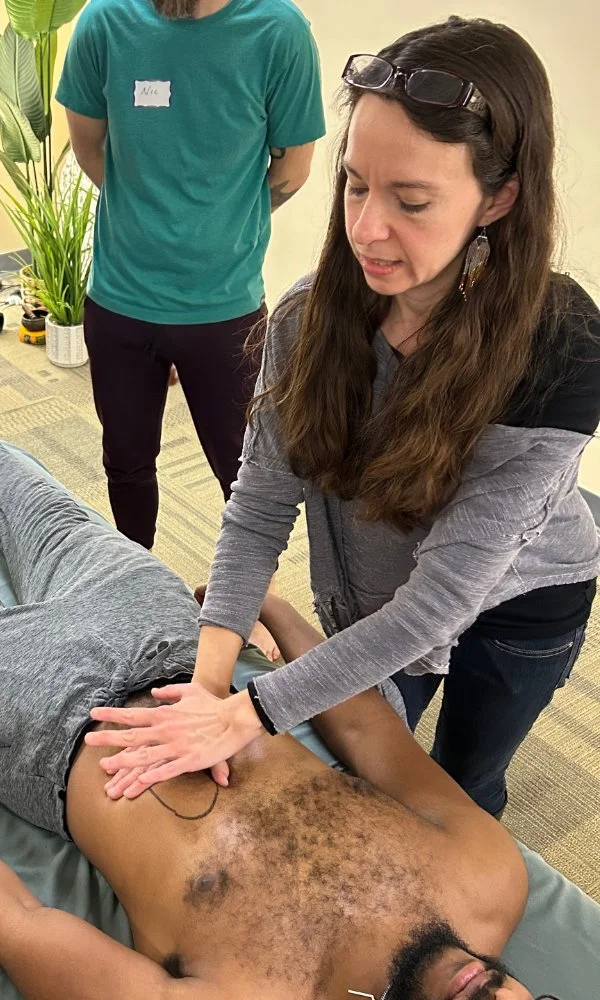

This class is open to all therapists who have a license to touch, including massage therapists, structural integration practitioners, physical therapists, chiropractors, doctors, and acupuncturists.
Note: This series is introductory and meant to orient you to working with the organs. I recommend your practicing with each other and/or joining my study group (located in Lawrence, KS) to become comfortable palpating organs so you can integrate this into your practice. Also, if this work resonates with you, I highly recommend your taking the more in-depth Visceral Manipulation courses offered through The Barral Institute.
Upper Abdominal Organs
Your Primary Digestive Center
This class explores the organs just below the diaphragm—stomach, liver, the first part of the small intestine, gallbladder, and pancreas. I call these organs the primary digestive center because they chemically digest food, a process that is critical for absorbing nutrients farther down the digestive tract. You will also get an overview of related structures—the esophagus, diaphragm, intestines, and the digestive sphincters.
The primary digestive center metabolizes life—processing all that is handed to you. Ayurvedic medicine calls this area the solar plexus chakra, which holds your personal power. Chinese Medicine says these organs harness the elemental powers of earth and wood, which provide nourishment and structure. In health, this area lets you nourish yourself, work hard, be responsible, and support others.
Lower Abdominal Organs
Your Absorbing Boundaries
This class examines the lower abdominal organs—the loops of the small intestine and the large intestine. It also introduces you to the peritoneum—the fascial sack that holds the intestines and other digestive organs; the organization of the blood and nerve flow of the abdominal organs; and the intestines’ relationship to the lower back.
The intestines absorb nutrients—carbs, fats, and proteins, as well as vitamins, minerals, and water. Through this process, they sort out the valuable nourishing parts of your food from the indigestible residue. They fight pathogens that enter your body, playing a huge role in your immune system, and they also produce large amounts of neurotransmitters that are indicated in happiness.
The intestines relate to the Ayurvedic sacral chakra, which generates creativity and emotions. In Chinese medicine, your small intestine carries the fire element, like the heart, and your large intestine conveys the strength of metal, like the lungs. In health, the intestines keep you well-nourished, healthy, and happy.
Thoracic Organs
Your Constant Energy
This class covers the organs of the chest cavity—the heart and lungs. It explores the heart’s chambers and major vessels—the aorta, vena cavas, and pulmonary vessels; the lungs’ bronchial tubes and lobes; and the thoracic organs’ fascial coverings—the pericardium and pleura. Their relationships to the diaphragm, esophagus, and upper back are also discussed.
The lungs constantly draw energy from the air around you, and the heart rhythmically distributes this energy to every cell of your being. Together, they provide your foundational life force and determine your vitality. The heart center also holds your deep sense of self and spirit, experiences your emotions, and connects you with others, while the lungs connect you to the present moment.
In the Ayurvedic system, this area is your heart chakra and holds love and healing. In Chinese medicine, your heart holds the power of fire, and your lungs carry the strength of metal. In health, they drive your life force, generate your vitality, ground you in the present, and give you the capacity to be loving and compassionate.
Kidneys and Pelvic Organs
Your Elimination, Reproduction, and Pleasure
This class includes the urinary tract—kidney, ureters, and bladder, as well as the uterus and rectum. It studies how the peritoneum separates these organs from the digestive tract above the pelvic organs and how the pelvic fascia connects these organs to the bones of the pelvis. It also presents an important blood pathway that feeds the pelvic organs, pelvic floor muscles, and gluteal muscles, connecting the strength of the pelvis to the health and placement of the pelvic organs.
The kidneys and pelvic organs perform a combination of very intimate activities–elimination of waste, reproduction of human life, and sexual pleasure. The kidneys filter waste from your blood so the bladder can eliminate it, and the rectum releases solid waste. The reproductive organs of the pelvis can miraculously create new life and provide exceptional pleasure.
The kidneys and pelvic organs relate to the Ayurvedic root chakra, which provides a sense of security and stability, and in Chinese medicine, the urinary tract relates to the water element, which provides your will and courage. In health, they root you to the earth, provide a sense of courage and trust, and make you feel safe and secure in relationships with others and yourself.